Proof of the work, and what it cost you to do it.
If you clean hotels or short-lets for someone else, you get paid on trust and you're argued with on memory. BedsReady puts the jobs on your cleaners' phones, closes each one with photos, and tells you whether the contract is making money.
No app to install · Cleaners sign in with a name and a 4-digit PIN
You're accountable for work you can't see.
Your staff are in someone else's building. The client's complaint arrives days later and the only record is what somebody remembers.
Disputes you can't win
The client says the room wasn't done properly. You believe your cleaner. Without a timestamped photo set it comes down to who sounds more certain, and it's rarely the contractor.
Contracts priced on a guess
You quoted a price per room. Whether that number survives contact with a bad Saturday is something you find out at the end of the month, in the payroll run.
Quality you can't evidence
Telling a client your standards are high is worth nothing. Showing them scored inspections across the month is a different meeting.
Your supervisor's morning, and your month-end.
Screens from the live product, running daily across our own hotel and short-let cleaning.
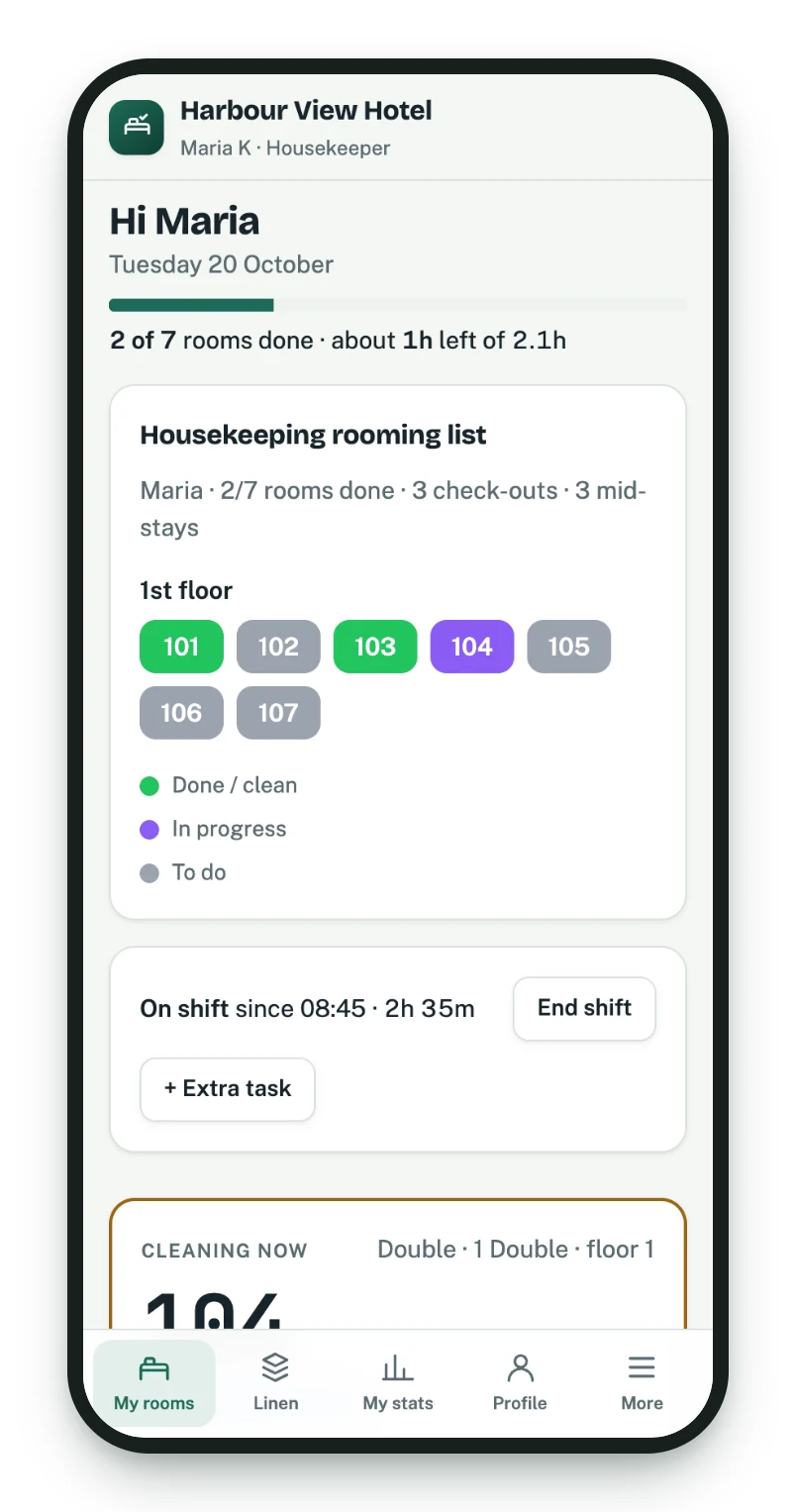
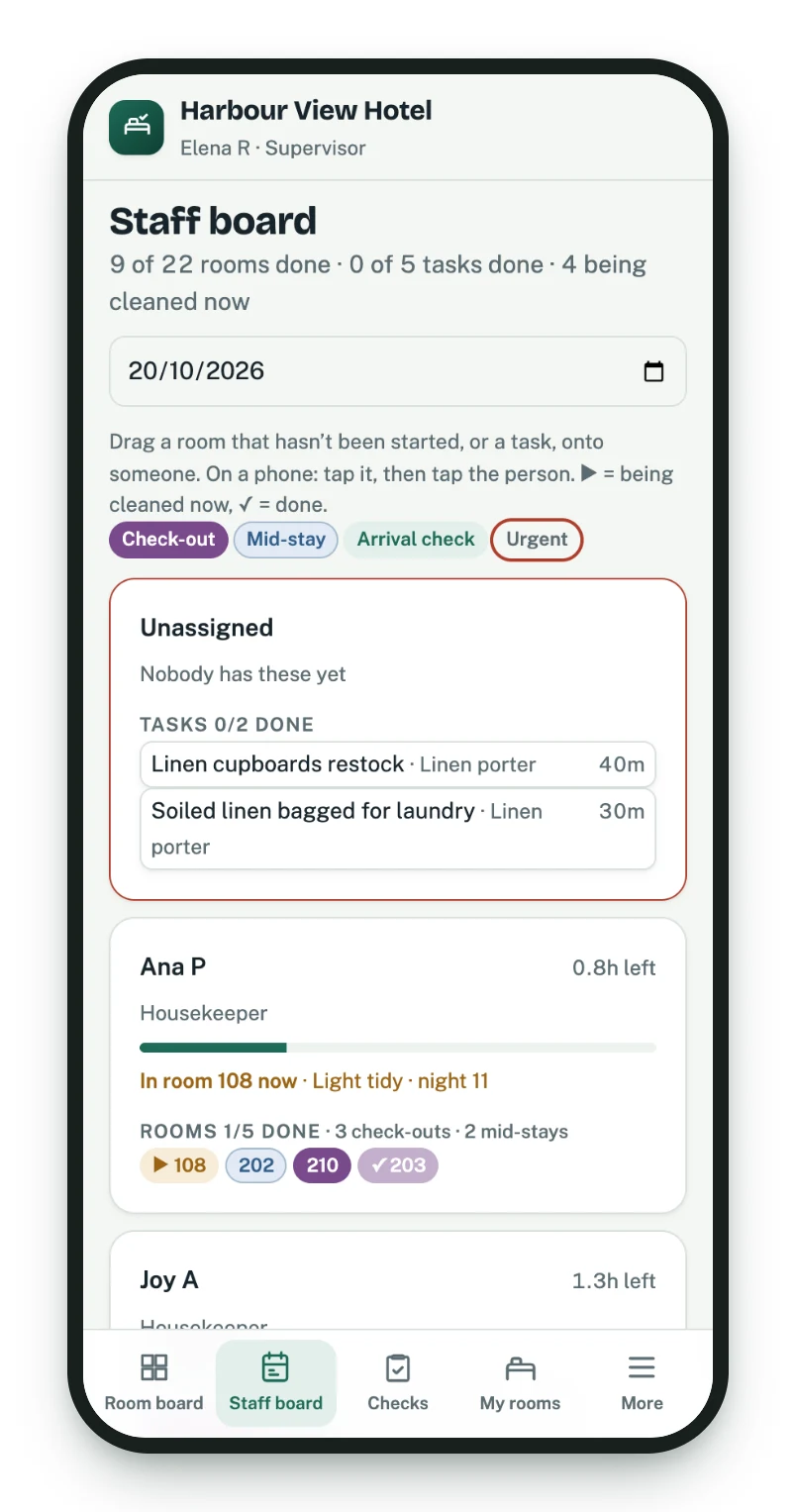
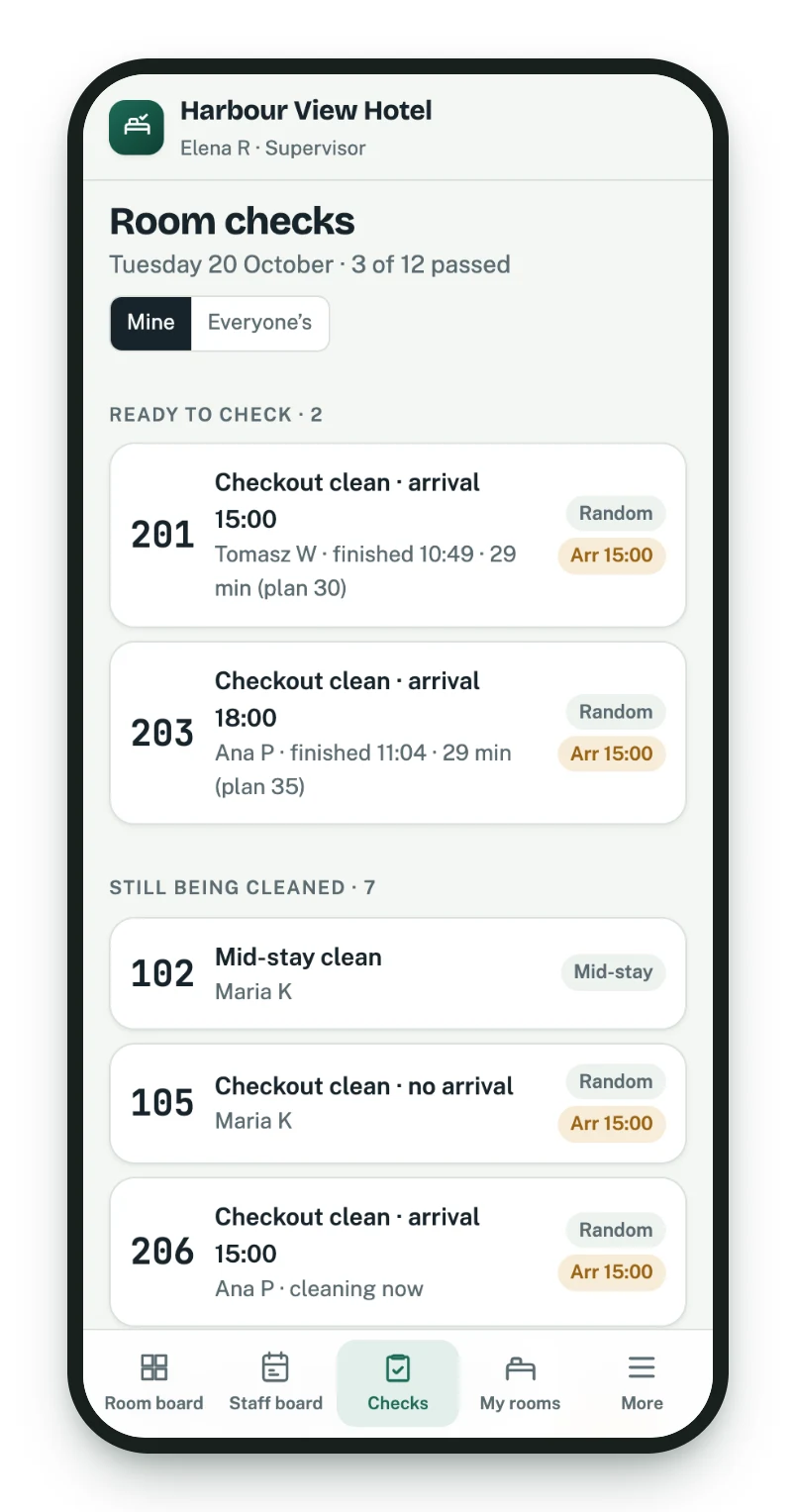
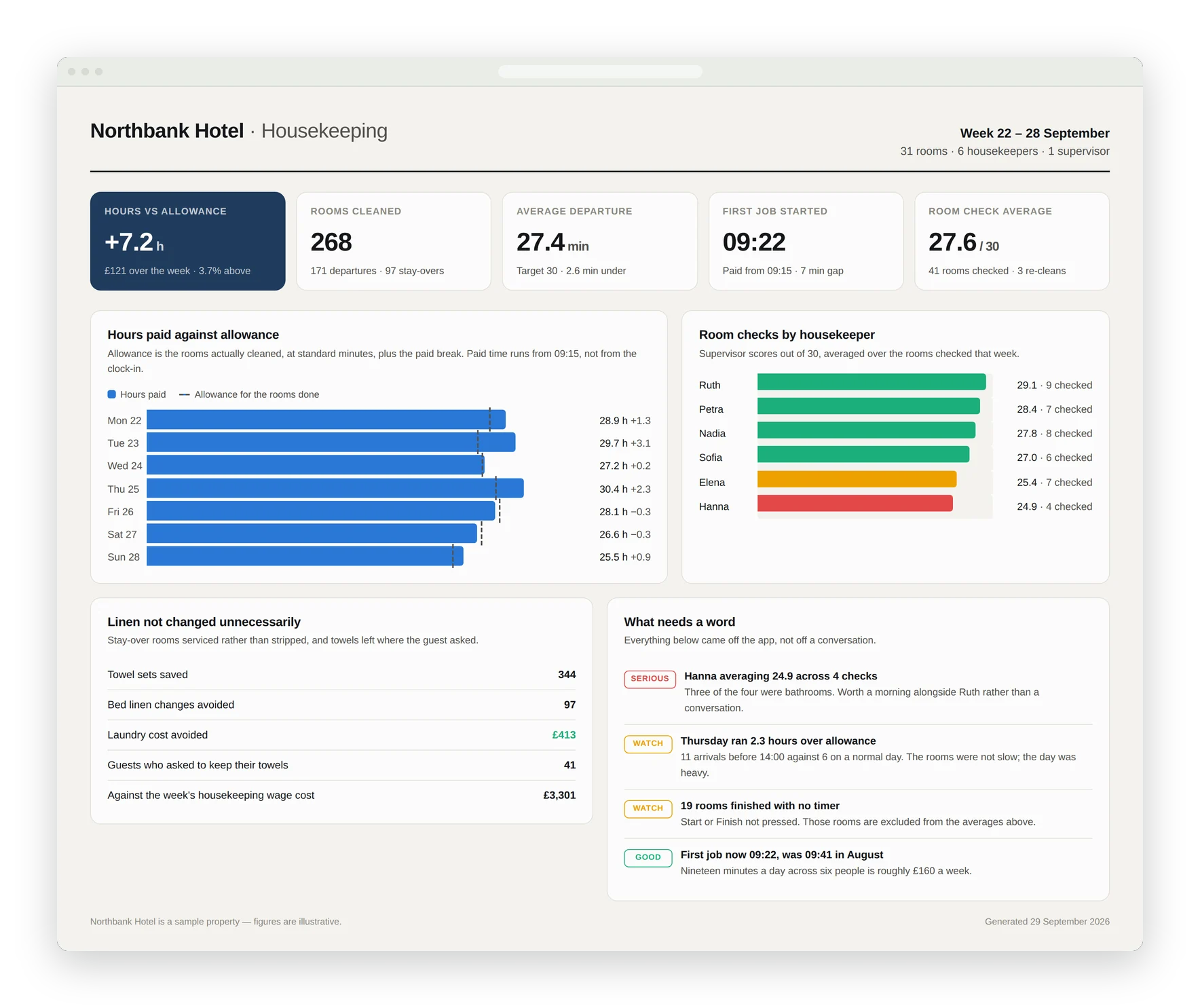
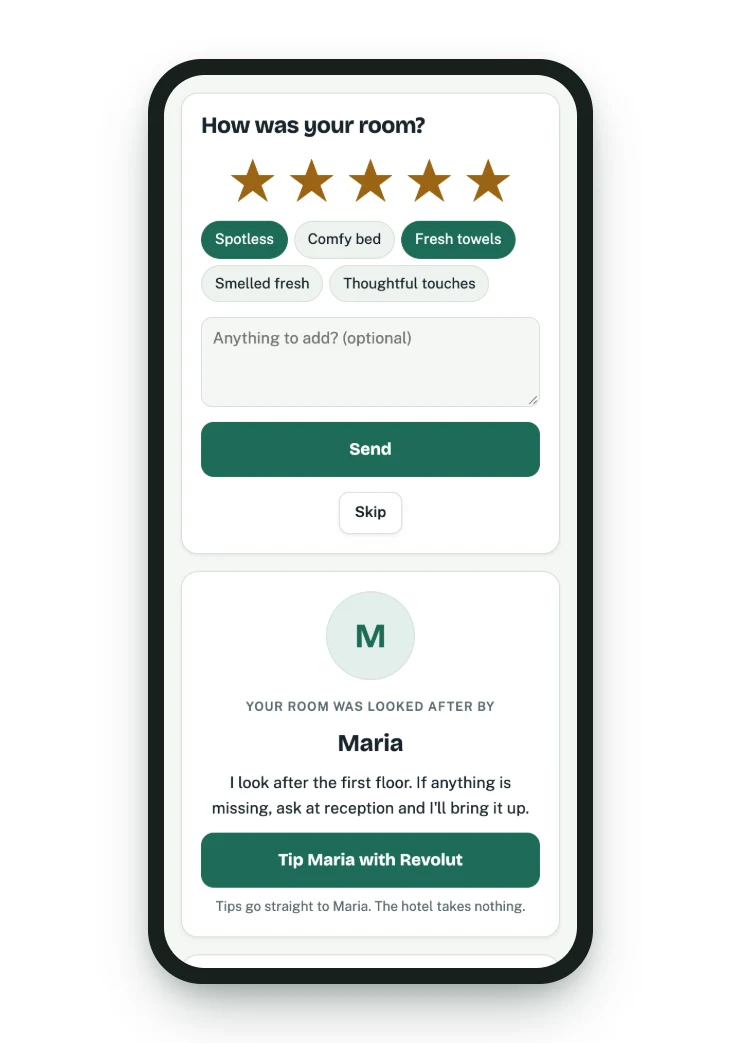
Your client hears the good ones too.
A QR code in the room lets the guest rate the clean. A problem comes back to you tagged and dated; so does everything that went right, which is the half your client never usually sees.
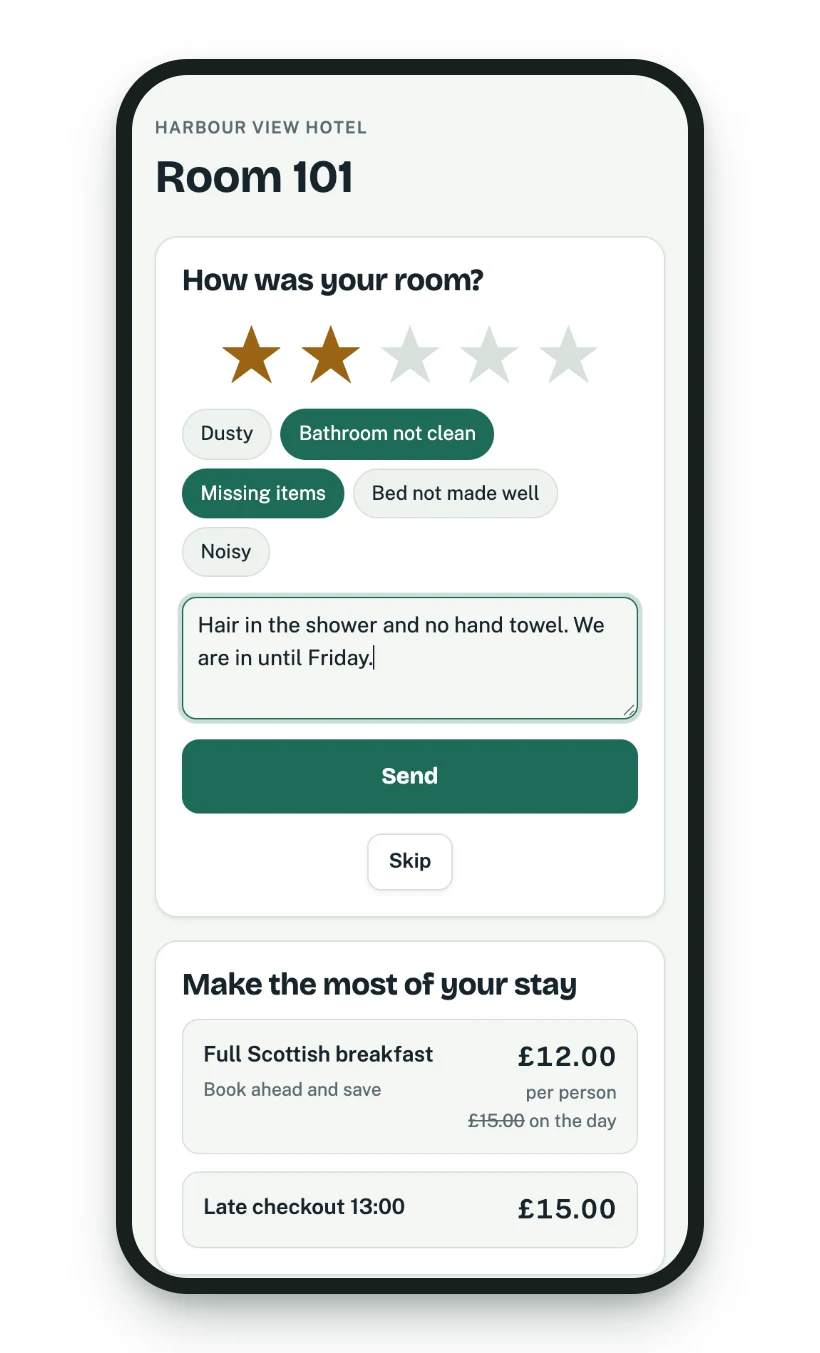
A low rating comes to you, not to the internet
Anything under par opens a short form: what was wrong, tagged by category, in the guest's own words — while they are still in the building and it can still be put right.
When a contract comes up for renewal, a month of guest ratings on rooms your team cleaned is a better argument than anything you can say about your standards.
And the cleaner gets the credit
The card names who looked after the room, with a line in her own words, and a tip link that goes straight to her. The business never handles the money.
It is entirely opt-in — nothing shows unless she has ticked the box — and good scores are recorded against her, not just the bad ones. Of everything we have put in front of our own team, this is the part they actually asked to keep.
Proof you reported it.
Your cleaner finds the damage. Three weeks later the client asks why nobody told them. A job raised from the room with a photo and a timestamp settles that conversation before it starts.
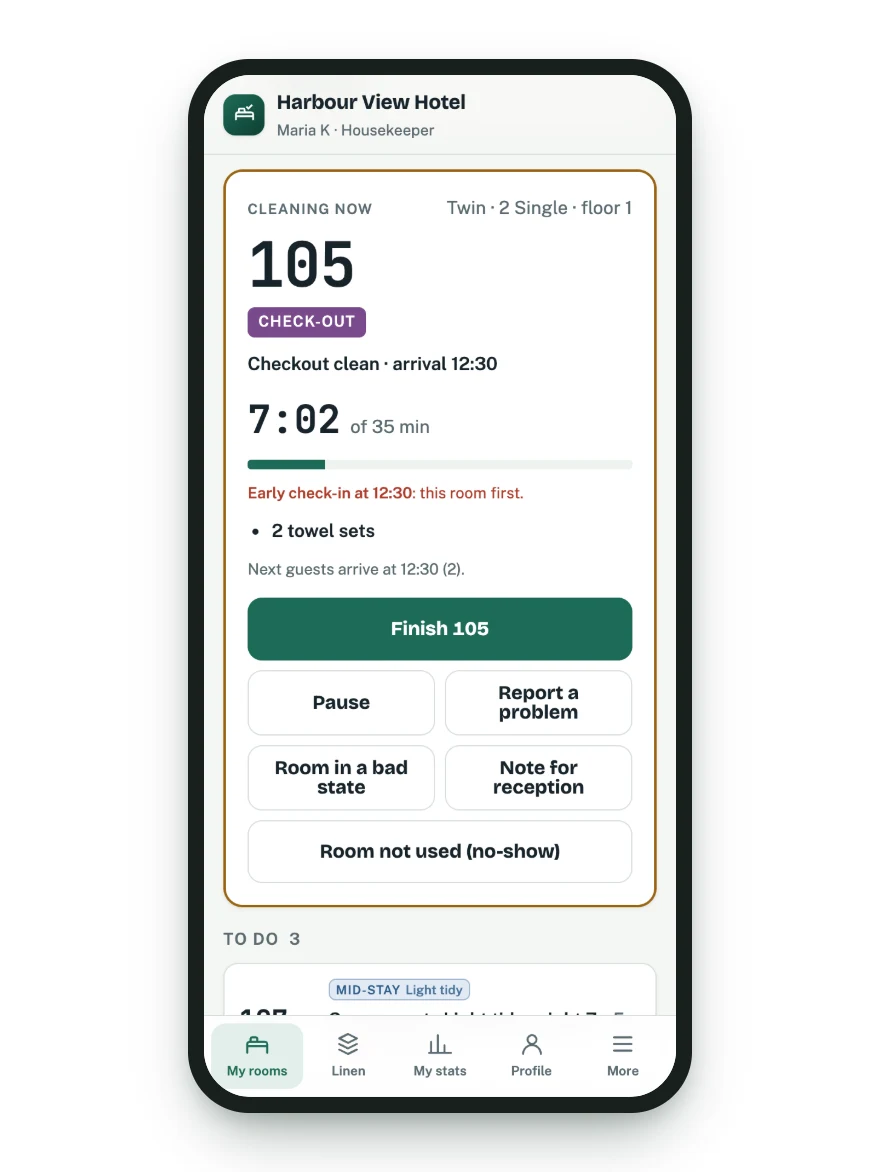
One queue, flagged for urgency, with the evidence attached
The cleaner raises it from the room, with a photo. It goes to whoever handles maintenance — your own lead, or the record you hand the client — flagged 1, 2 or 3.
It sits there until it is closed. Not a list somebody has to remember to open: an open job that doesn't clear itself. In our own hotels a 1 means inside 48 hours, a 2 within the week and a 3 in due course; you decide what they mean for you.
The client can see what was raised and when. The record is yours, so a renewal is a conversation about evidence rather than about who remembers what.
Closed jobs keep their notes and what they cost, against the room. So when the same shower tray comes back for the third time in a year, that shows up as a fact rather than a feeling.
What's in it for a contractor.
Evidence on every job
Photos, timestamps and who did it. The dispute ends with a file rather than a phone call.
Agency and casual staff without onboarding
A link and a 4-digit PIN. Someone covering a Saturday is working in two minutes, not signing up for anything.
Hours against allowance, per contract
Set the standard minutes for each job type. You see the gap daily, so a contract that's slipping is a conversation in week one rather than a loss in month three.
Inspections you can show the client
Scored out of 30 against your own checklist, averaged by cleaner and by site.
Nobody turned up — handled
Reassign the round from the supervisor's phone and the affected cleaners' lists change underneath them.
Faults raised from the job
Your cleaner reports the client's broken fitting with a photo, which protects you when it's later described as damage.
Guest ratings on your work
The in-room QR code gathers what guests thought of the rooms your team cleaned — evidence for the renewal conversation, and an early warning when a site starts slipping.
Something for the cleaners, not just the client
Guests can tip your staff directly through the same card and the business never handles it. In a trade where people leave for fifty pence an hour, that matters more than it should.
This isn't a mockup.
BedsReady grew out of software we built to run our own hotel and short-let cleaning, and have been using daily since 2025.
What contractors ask us first.
Can I run several clients in one account?
Tell us how your contracts are structured when you get in touch — multi-client setup is exactly the kind of thing we want the first contractors outside our own group to shape, rather than us guessing at it.
Does it do invoicing or payroll?
No. It produces the hours and the completed jobs behind both, which is the part that's usually wrong. Payroll and invoicing stay where they are.
Can the client see anything directly?
Not today. You export or show what's useful. A client-facing view is worth building and we'd rather build it with a contractor than for one.
What if my cleaners aren't confident with phones?
The job screen is large type and big buttons, and finishing a room is one tap. It was built for a real housekeeping team, several of whom told us exactly what they thought of the first version.
What does it cost?
Pricing is being set with the first operators outside our own group. Ask for early access and you'll hear a date and a price before anyone else.
Cleaning your own rooms instead?
Tell us what you clean.
Set BedsReady up yourself today, or leave your details and we'll talk you through it first. No obligation, and we won't pass your details on.
Ready to start? Create your account in three short steps: your business, your login, then your cleaners. Your customers can book online and set up regular cleans straight away.
Create your accountOr leave your details below and we'll be in touch.