What the big chains give a housekeeper — and what a room actually takes.
Ask a hotel group how long it takes to clean a room and you won't get an answer. The number exists. It just isn't published.
Every chain of any size runs to a labour standard, and that standard is what the rota is built from. It sits in an operations manual and it is treated as commercially sensitive, because it is. So the only public record of what a housekeeper is actually given comes from the people doing the work.
What housekeepers say they're given
Housekeepers at one of the UK's largest budget chains have been describing their own targets on public review sites for years. The figures are remarkably consistent:
- “26 minutes, but to finish on time you usually need to get rooms completed in 20.”
- “You're supposed to have 30 minutes per room. However, with the amount of rooms and expected finish times they give you, they really expect you to do them in 15–20.”
- An older standard, remembered by a former housekeeper: “12 minutes for a stay and somewhere between 20–25 for a depart.”
- Twelve rooms in a normal shift. Eighteen on a bad one, including quad set-ups.
Read those together and a shape appears that anyone who has run a floor will recognise. There is a nominal number — around thirty minutes — and there is a real number, which is what the finish time actually implies. The real number is closer to twenty.
Two caveats, because they matter. These are self-selected reviews: people rarely write one to say the workload was fine, so the reported times skew tight. And it's one chain, mostly one format — compact, standardised, budget rooms, among the easiest in the country to clean quickly. Treat them as a signal, not a benchmark.
But the gap between the two numbers is the signal. And that gap isn't one chain's problem. It's structural.
Why the official number and the real number diverge
Nobody sets out to publish thirty and mean twenty. It happens because of how the two numbers are produced.
The standard minute is set once, on a clean case: a departure, trolley stocked, no maintenance issue, nobody in the room, a housekeeper who knows the property. It is an honest estimate of the work.
The finish time is set every morning, and it is set by arithmetic that has nothing to do with the standard. Rooms out, staff on, check-in at two. If two people called in sick and the arrivals didn't move, the minutes per room are whatever is left after the division. The standard doesn't change. The time available does.
Then there is everything the standard quietly excludes.
The nominal number describes the work. The real number describes the day. The difference between them lands on one person, quietly, every morning.
What breaks when you run at the real number
Squeeze long enough and it comes out somewhere. In our own properties it has come out in three places, every time.
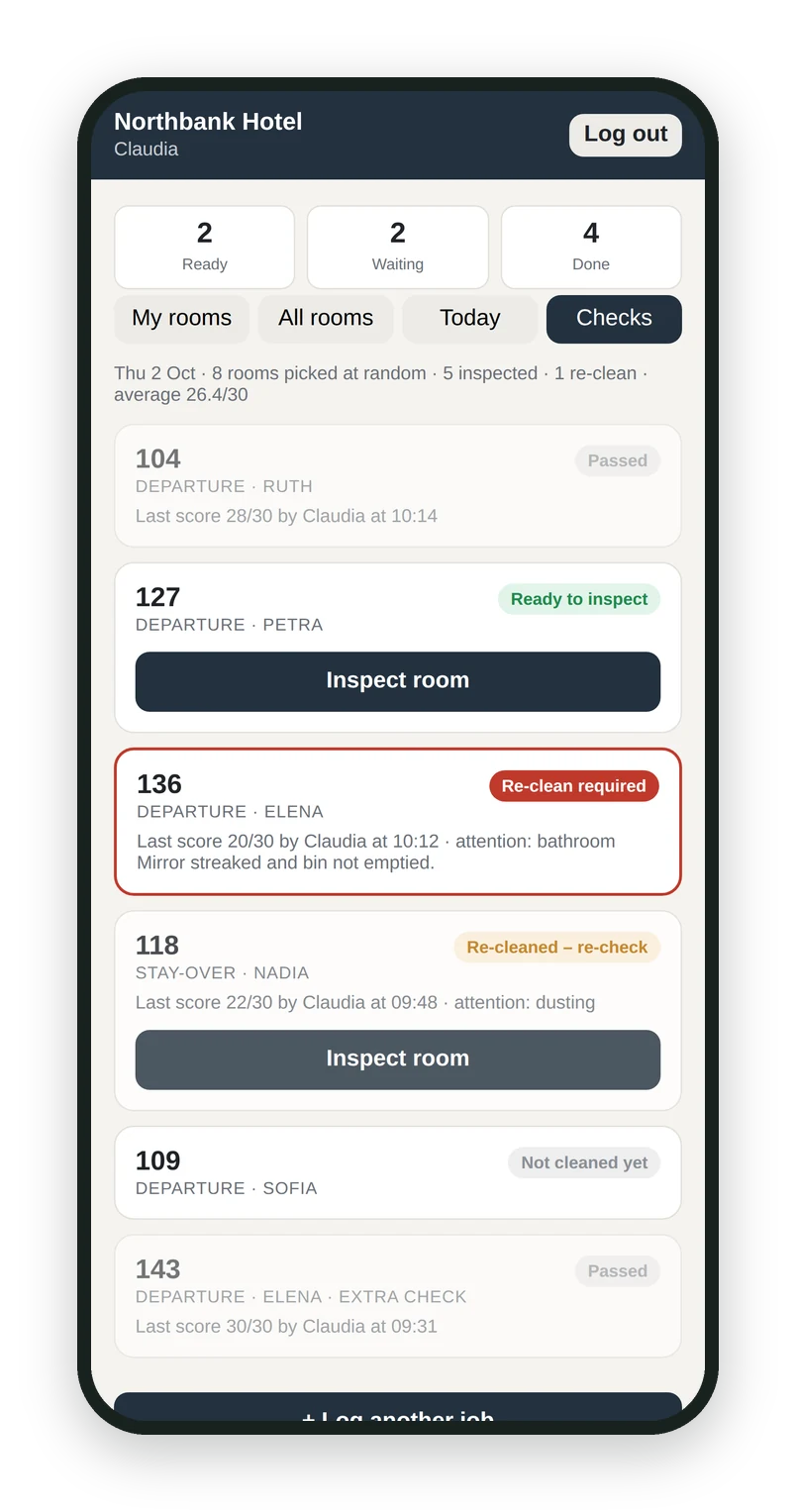
Room checks slip first, and they slip silently
Nobody skips the bed. People skip under it. They skip the shower screen, the kettle, the second glass. It doesn't show on the day. It shows six weeks later, in a review that mentions the bathroom.
Then complaints arrive late, which is the expensive kind
A guest who notices something at check-in tells reception, and reception fixes it. A guest who notices it in the shower on the second morning tells the internet on Friday. By then nobody can establish what the room looked like at eleven o'clock on Tuesday, so the claim gets settled rather than answered.
Then the cleaners leave
This is the one that actually costs money, and it never appears in the housekeeping line. Somebody who is quietly set up to fail every morning doesn't resign in protest. They take a job at the place down the road that isn't ten minutes short. Then you are recruiting, inducting and running with agency cover, all of which cost more per room than the minutes you saved.
Every operator we've spoken to recognises at least two of the three. Almost nobody can put a number on any of them, because the hours are recorded in one place, the room checks in another, and the leavers in a third.
What we do instead of guessing
We stopped estimating and started measuring. Not the standard — the actual.
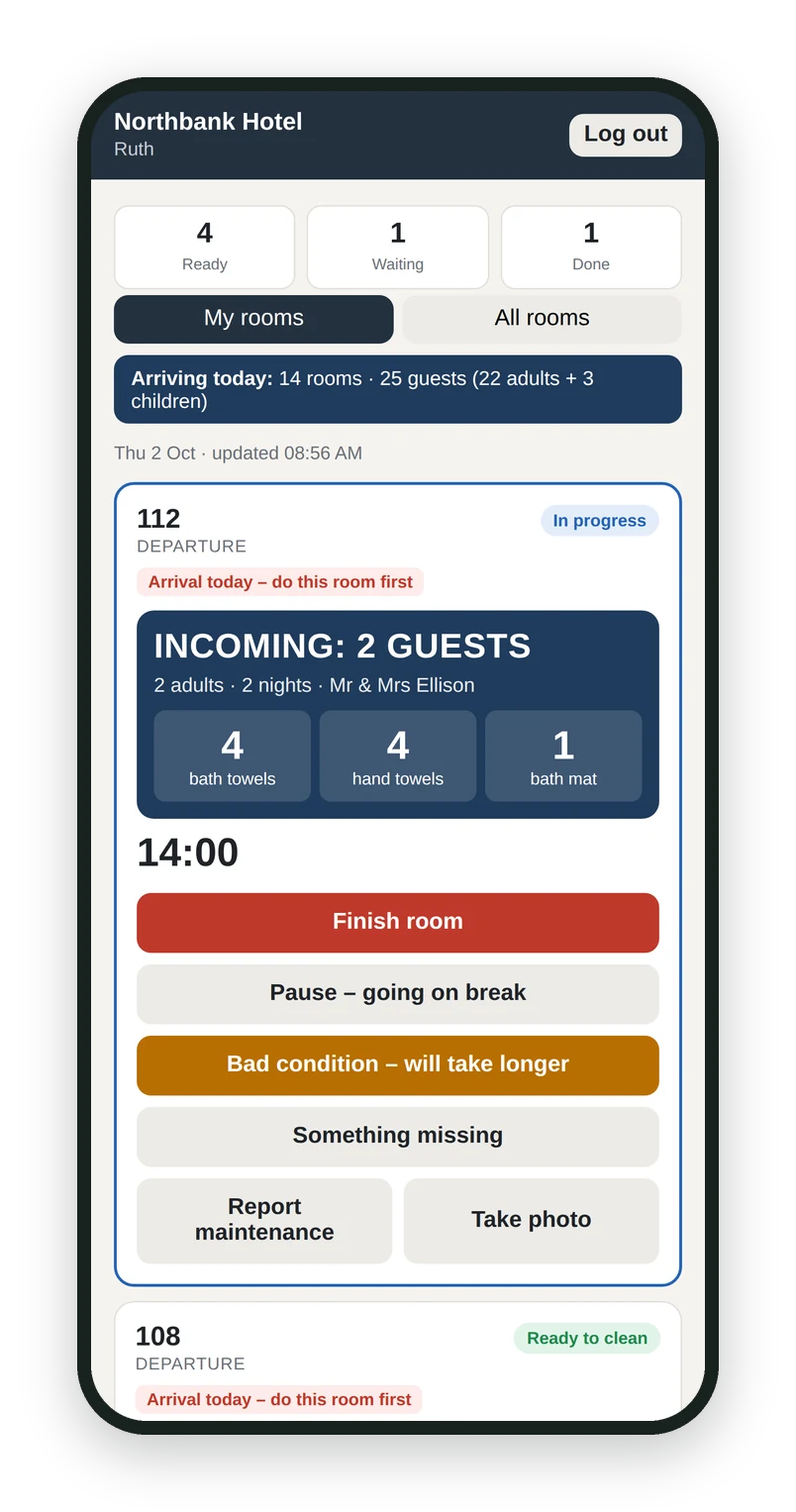
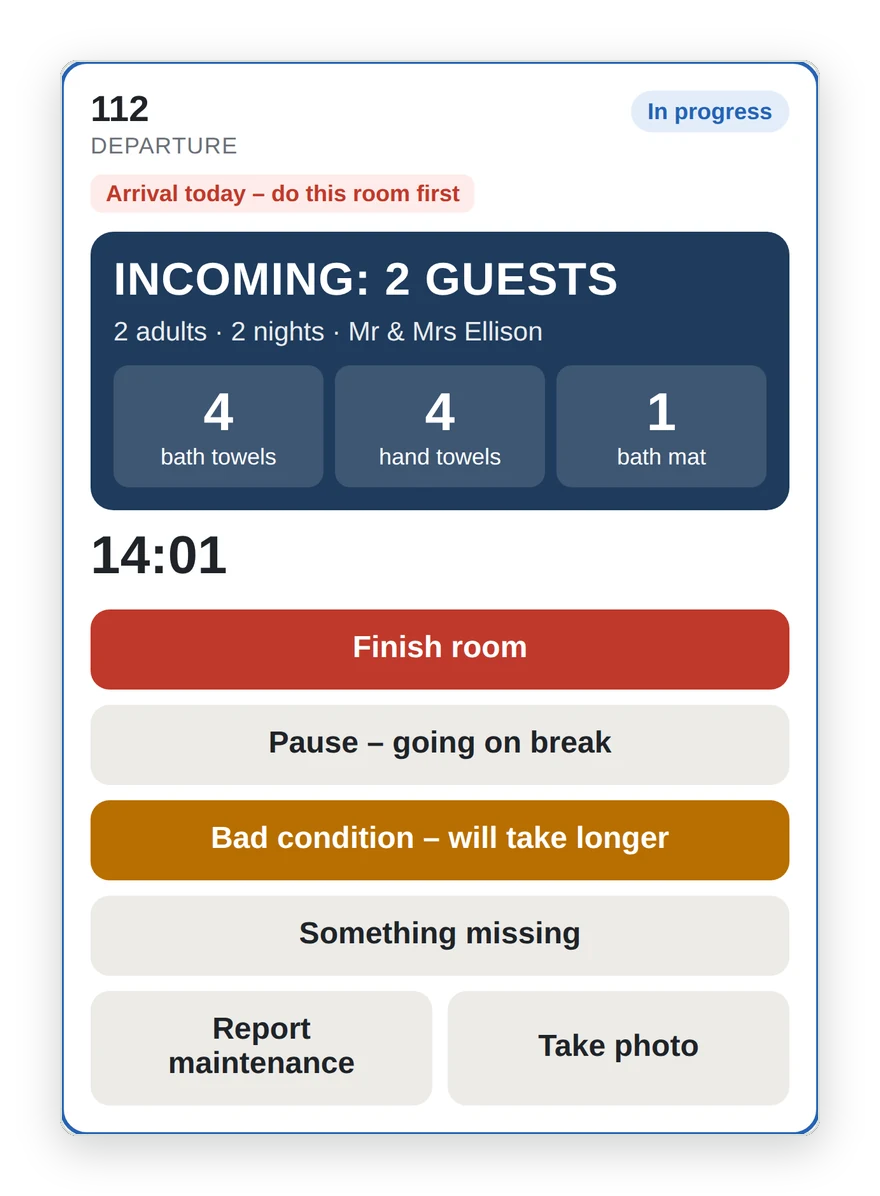
Every job on our properties is timed from the moment it is started to the moment the photos close it. That gives a real distribution rather than an average: not “a two-bed takes X”, but how long it takes on a Tuesday versus a Saturday, for a departure versus a stay-over, for the cleaner who has done it four hundred times versus the one in her second week.
Against that we set the standard we have chosen, and the gap between the two — priced at the fully loaded hourly rate, not the headline wage — is reported weekly. Alongside it: room check scores by housekeeper, so a slipping standard shows up as a trend and not as a review.
None of that is clever. It is just counting something that usually doesn't get counted.
What our numbers say
We know what a departure takes in our properties, by room type, and what the gap between allowed and clocked is worth over a year. We are not publishing those figures, and it isn't coyness.
It's that they would mislead you. Our minutes are our room sizes, our linen, our layout, our team, our arrival profile. A number from a 48-unit short-let operation tells you very little about a 31-room hotel, and quoting it as a benchmark would be exactly the kind of context-free statistic this article is arguing against.
What is worth doing is the comparison. Tell us your room count, your arrivals profile and what you currently allow per turn, and we'll tell you what we measure against a comparable shape, where we would expect your gap to be, and what it is probably costing you. That's a conversation rather than a download, because the useful part is the interpretation.
Find your own number first
Our housekeeping cost calculator works out what a room turn costs you in your own figures. Two minutes, nothing to sign up for, nothing sent anywhere — it runs entirely in your browser.
If the number it gives you looks wrong, that's worth a conversation too. It usually means the allowance and the rota have quietly stopped agreeing with each other.