48 units, one week to switch, and a £350 claim that didn't stick.
Until June 2026: forty-eight units, eight cleaners, and a WhatsApp group holding it all together. Here is what actually changed when the turnovers moved onto BedsReady — including the parts it didn't fix.
Four tools, none of them talking to each other.
The rota lived in a Google Sheet. The day's changes went out on WhatsApp. Owners and guests came in by email. Anything urgent was a phone call. None of it joined up, and all of it depended on somebody remembering to tell somebody else.
With eight cleaners covering 48 units, the group chat carried most of the day's coordination. The practical problem with that is not that it fails. It is that it works just well enough. A cleaner posts “done” at 13:20 and you believe her, because she has never given you a reason not to. What you don't have is any record of what “done” looked like. Three days later, when someone says the flat was filthy, the only thing in your hand is a message that says done.
The other cost is quieter: four cleans a day inside a one-mile radius only works if the order is right. Get it wrong and a cleaner is doubling back across the same streets, and the 15:00 check-in is the one that suffers.
A week, start to finish.
Properties in, cleaners set up with a name and a four-digit PIN, standard minutes set per property type. No app to install, which matters when the team changes. Everything below is what the months since have actually looked like, not what we hoped for in week one.
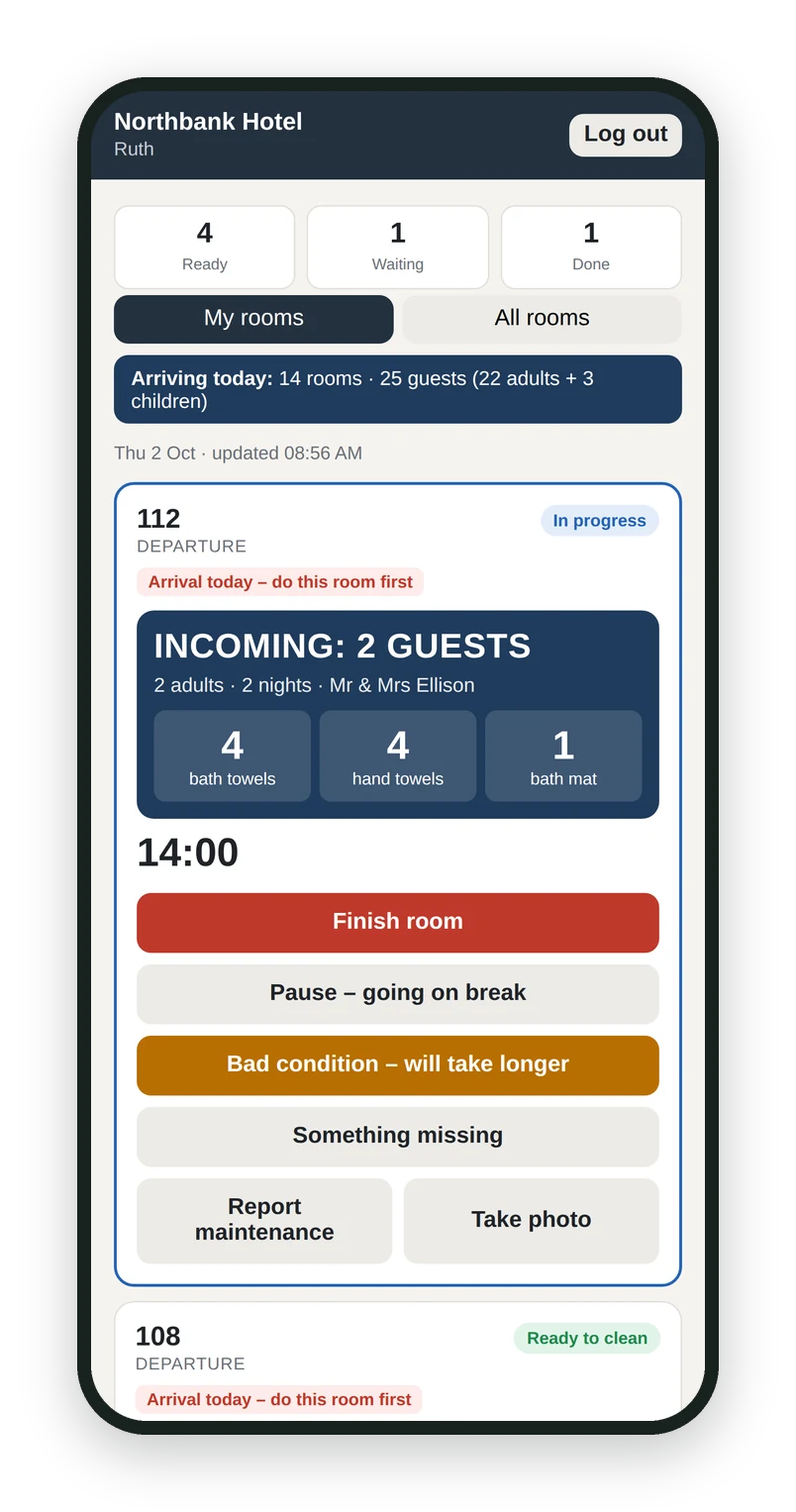
The list replaced the group chat
Each cleaner opens a link and sees her own day, ordered by when the next guest arrives rather than by whoever shouted loudest. Changes land on her phone instead of in a thread she has to scroll.
The WhatsApp group still exists. It is just no longer where the work lives.
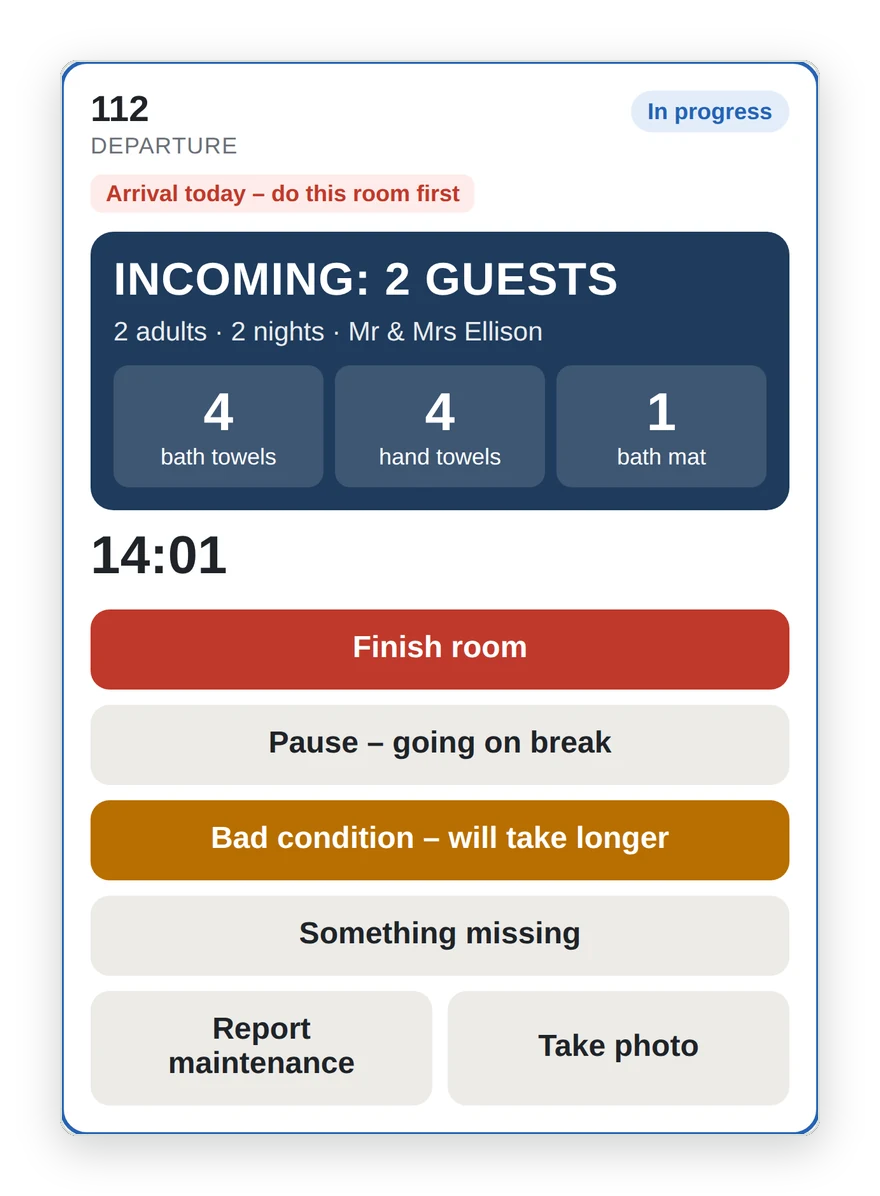
The timer made the standard real
85 minutes for a two-bed was always the number in our heads. It became a number on a screen: started at, finished at, against the standard.
That changed the conversation with cleaners from an impression to a measurement — in both directions. A property that consistently runs over is usually the property's fault, not the cleaner's.
“The beds weren't made and there were no towels.”
A guest complained that they had arrived to unmade beds and no towels, and asked for the night refunded. Three hundred and fifty pounds.
Before, that is an argument you lose politely. You have a cleaner who says she did it, a guest who says otherwise, and a platform that tends to side with the person holding the booking. You refund, you apologise, and you privately wonder which of them was right.
Instead we opened that morning's clean and looked at the photo set. Beds made. Towels laid out. Timestamped, in that property, that day.
The refund wasn't paid. That single set of photos covered a year of what the system costs to run — and, just as usefully, the cleaner was shown to be right.
Four things, in the order we noticed them.
Disputes stopped being arguments
A complaint now gets answered with a dated photo set instead of a recollection. It also works the other way: when a guest is right, we can see that too, and fix it without a row.
The chasing stopped
Nobody rings round at two o'clock to find out which flats are ready. The board says. The phone is now for things that have actually gone wrong.
A turnover has a number
85 minutes for a two-bed, four cleans per cleaner per day. Those were estimates before. Now they are measured, which means the price we charge for a turnover can be checked against what it costs to do.
The spreadsheet went
No rota to rebuild every week, no printouts, no version of the day that is already out of date by nine o'clock.
The honest part.
Guest messaging is still a separate problem. We handle guest communication with AI assistance and we are still working out how far to take it. BedsReady does not touch it. If you are hoping one system will do turnovers and talk to your guests, this is not that system.
There is no channel manager or PMS connection yet. The day's checkouts and arrivals come in from the report we already produce. It works, but it is a step we would rather not have.
It does not make a bad round good. Four cleans a day inside a mile works because the properties are close together. Software sequences the day; it does not move the flats.
What we'd say to another operator.
Start with the photos. Everything else on this page is an efficiency; the photo set is the thing that changes your exposure. If you do nothing else, get a timestamped record of every turnover.
Set your standard minutes before you switch, not after. If you turn the timer on without agreeing what good looks like, the first week's numbers just make everyone defensive.
And be honest about the radius. Our four-a-day only holds because of the one-mile geography. Work out your own number from your own map before you promise anyone anything.
Tell us what you run.
We're opening BedsReady to a small number of operators outside our own group. Leave your details and we'll be in touch with a date and a price before anyone else sees it. No obligation, and we won't pass your details on.
hello@bedsready.com